

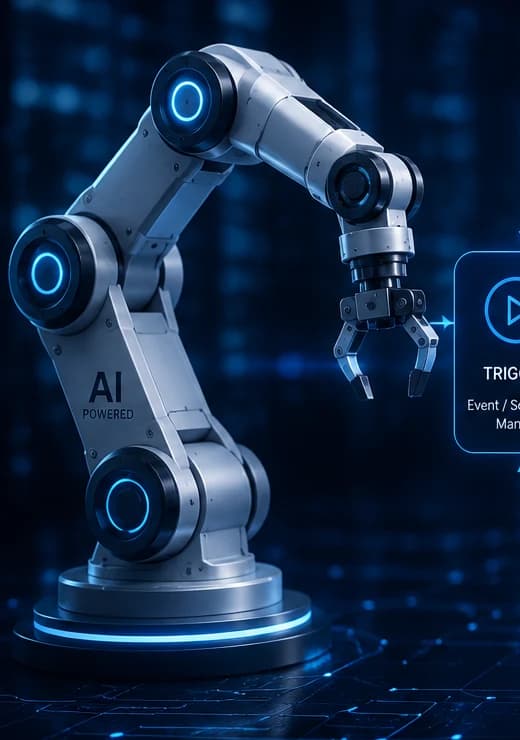
A step-by-step framework for understanding a manual process, choosing the right automation and introducing AI without automating confusion.
Map the work before selecting technology
Manual workflows are often understood differently by each person involved. Before automation, document the trigger, required information, sequence of actions, decision owners and common exceptions. This reveals whether the problem is repetition, unclear responsibility, disconnected systems or missing data.
A process that changes every week is not ready for rigid automation. Clarifying the operating rule first prevents technology from making an unstable workflow faster but harder to correct.
Separate rules from interpretation
Some steps are deterministic: validate a required field, assign a due date or notify an owner. Others require interpretation, such as identifying the intent of a message or summarising a document. Rules should handle predictable decisions; AI should be considered only where language or pattern recognition creates real value.
This separation makes the workflow easier to test. A team can verify the business rule independently from the model output and create a manual fallback when the AI response is uncertain.
- Use rules for known conditions and commitments
- Use AI for bounded interpretation or generation
- Keep authoritative source data visible
- Escalate ambiguous or sensitive cases
- Record important actions and corrections
Choose one measurable pilot
A good pilot is frequent enough to observe and limited enough to review. Examples include routing website enquiries, preparing an internal summary or creating follow-up tasks from an approved event. Establish a baseline before launch so the team can compare time, quality and exception rates.
Run the pilot with a responsible owner. Collect failures, unclear cases and employee feedback. If the workflow creates additional checking or moves effort elsewhere, improve the underlying process before expanding it.
Connect systems carefully
Automation becomes valuable when information moves reliably between the systems where work happens. Every integration needs authentication, permission boundaries, validation and error handling. Duplicate events and partial failures should be expected and managed deliberately.
Sensitive data should be minimized before it reaches an AI provider. Teams need to understand retention, logging and training policies, and should avoid sending information that is not required for the task.
Treat improvement as part of the workflow
Products, policies and team responsibilities change. Automation therefore needs an owner who can update rules, review provider changes and monitor failures. Documentation should explain the purpose of the workflow as well as its technical connections.
The move from manual work to intelligent automation is successful when people gain clearer responsibility and better information—not simply when fewer clicks are required. A maintained process can then support broader automation with less risk.
Frequently asked questions
Should an unclear process be automated?
Usually not. Clarify ownership, rules and exceptions first so automation does not preserve the wrong process.
What makes a useful automation pilot?
It should be frequent, bounded, measurable and safe for a person to review.
How should AI uncertainty be handled?
Use confidence thresholds, source visibility and a clear path to human review or a deterministic fallback.
Continue the conversation
Explore the relevant service or share the business requirement through the existing enquiry flow.
Discuss Your Workflow